


When a claim leaves your office, the health plan only views the dates, charges, and diagnosis codes. It does not see your waiting room or the visit duration.
If an ICD-10 code does not align with the visit note or payer rules, payment can be delayed, reduced, or denied. Then your staff has to go back, fix the code, and resubmit the claim.
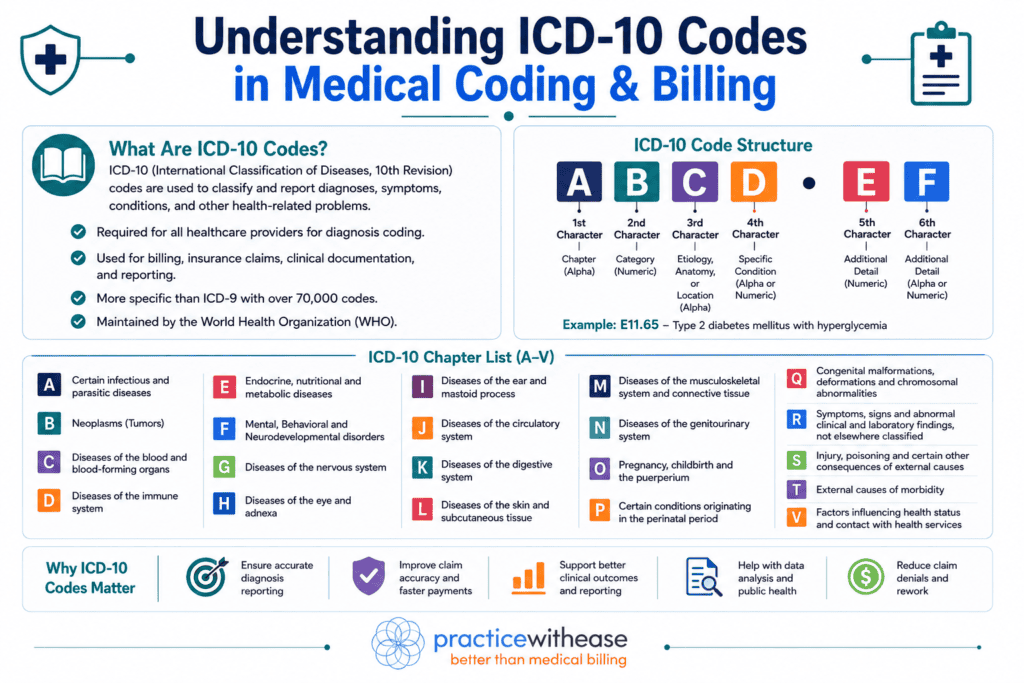
Small practices and clinics use at least one ICD-10 code on almost every claim. Practice With Ease assists local teams in obtaining the correct diagnosis code and regulation set for the services, and in retaining a larger share of the money the practice has already generated.
The Reason Why ICD-10 Diagnosis Codes Are Important
The front desk and billing staff often hear the term ICD-10, but usually do not have a clear understanding of it. An ICD-10 code is a mix of letters and numbers that indicates to the payer the patient’s condition, illness, or symptoms. The payer reviews this code to determine whether the visit is appropriate and should be paid.
If the diagnosis code fits the note and the service, the claim usually moves faster. If the code is too vague, does not match the story in the chart, or is missing, the plan may treat that line as if it does not belong on the claim at all. One small diagnosis line can change the payment for the whole visit.
Main Parts of the ICD-10 Coding System
It will help the staff understand how a short code can represent an entire line of an ICD-10 diagnosis code list while corresponding to the words used in the visit note.
Here are some major concepts:
- Each visit includes a note that tells a story. The ICD-10 code summarizes that story into a brief diagnosis line that the payer can understand.
- There are many thousands of ICD-10 codes, but your practice will mostly use a smaller group repeatedly.
- The first letter in a code points to a body system or type of problem. The following letters and numbers provide additional details, like the location.
- The ICD-10 code for anemia is usually D64.9 when the chart is unclear about the type of anemia.
Practical Advice to Implement ICD-10 Codes
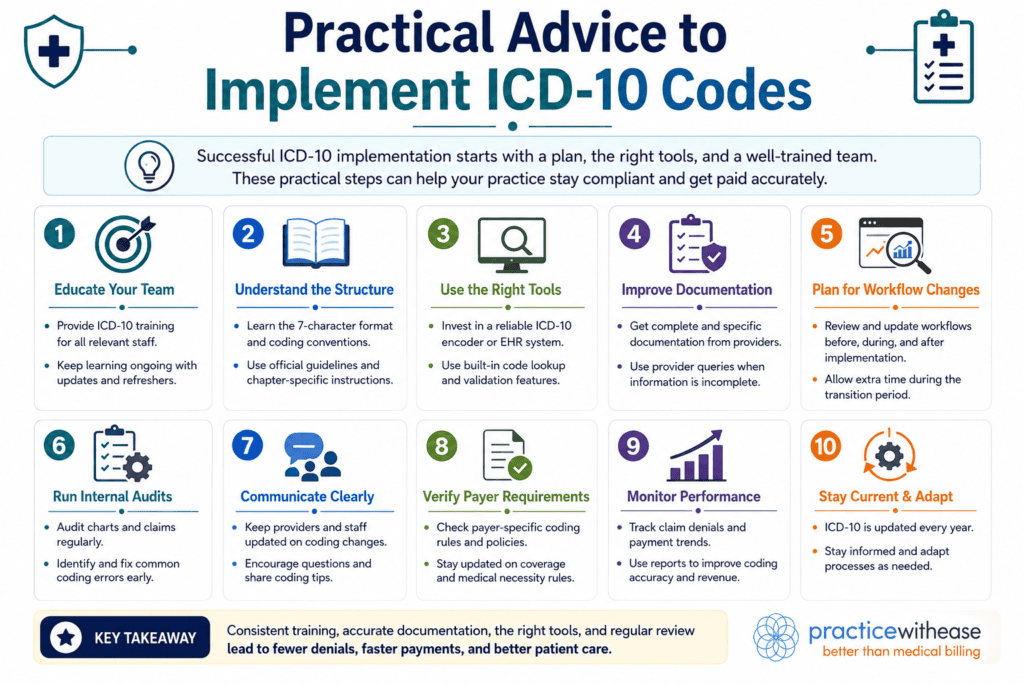
ICD-10 can be a regular practice once your team has the basics in place. There is no need to memorize a full list of ICD-10 diagnosis codes. You must have a smooth method for dealing with code lookups to make it look like a routine habit rather than a new issue every time.
Simple ICD-10 Workflow Practices
Teams that handle claims every day can better control revenue by following a few simple steps. They should always start with the visit note rather than a code they remember. The provider’s description of the problem should guide the search, and then the ICD-10 code should be verified to ensure the meaning matches the chart.
Your office can keep a list of ICD-10 codes, for each specialty, like the ones that come up a lot, instead of trying to remember them all. Short review talks where providers and billing staff walk through hard cases together help bring documentation and code choice into better lines over time.
Frequently Asked Questions (FAQs)
What is an ICD-10 code, in basic words?
An ICD-10 code is a standardized medical shorthand used by doctors and health insurance companies to label every possible disease, injury, and symptom.
What about such codes as the ICD-10 code for anemia or ICD-10 code of cough?
When the chart does not yet provide more detail, use common codes such as D64.9 for anemia or R05.9 for cough.
What is the number of ICD-10 codes, and is that an issue with a small office?
ICD-10 codes are numerous, and the small office will only use a limited number. The important point is the ability to locate the appropriate code when needed.
Contact Practice With Ease for ICD-10 Support Today!
We review visit notes, diagnosis patterns, and denied claims to see where code choices may be lowering payment. We also help refine your common diagnosis lists and support staff with simple workflows that fit your day. Practice With Ease collaborates with medical offices and clinic teams to simplify ICD-10 coding and reduce stress.