


Denied OON claims cost practices monthly, but they are not always gone for good. Most denials occur for a specific reason, and many of those reasons can be resolved with the right follow-up.
Providers also have state-level protections on top of federal rules, giving practices more options than most billing teams are aware of.

Practice With Ease helps medical practices recover reimbursement for claims insurers refuse to pay.
Common Reasons Out-of-Network Claims Get Denied
Insurance companies deny OON claims for specific reasons. Those reasons appear on the Explanation of Benefits document after each rejection. Coding errors cause more denials than most practices expect.
If prior approval was not obtained, the insurer can deny claims even if maintenance was necessary. These are all fixable problems, but they need to be caught and acted on quickly before deadlines pass.
What to Do When a Claim Gets Rejected
A denial letter is not the final term. Practices that follow up the right way recover a large portion of initially denied claims. Acting fast and sending the right paperwork the first time makes all the difference.
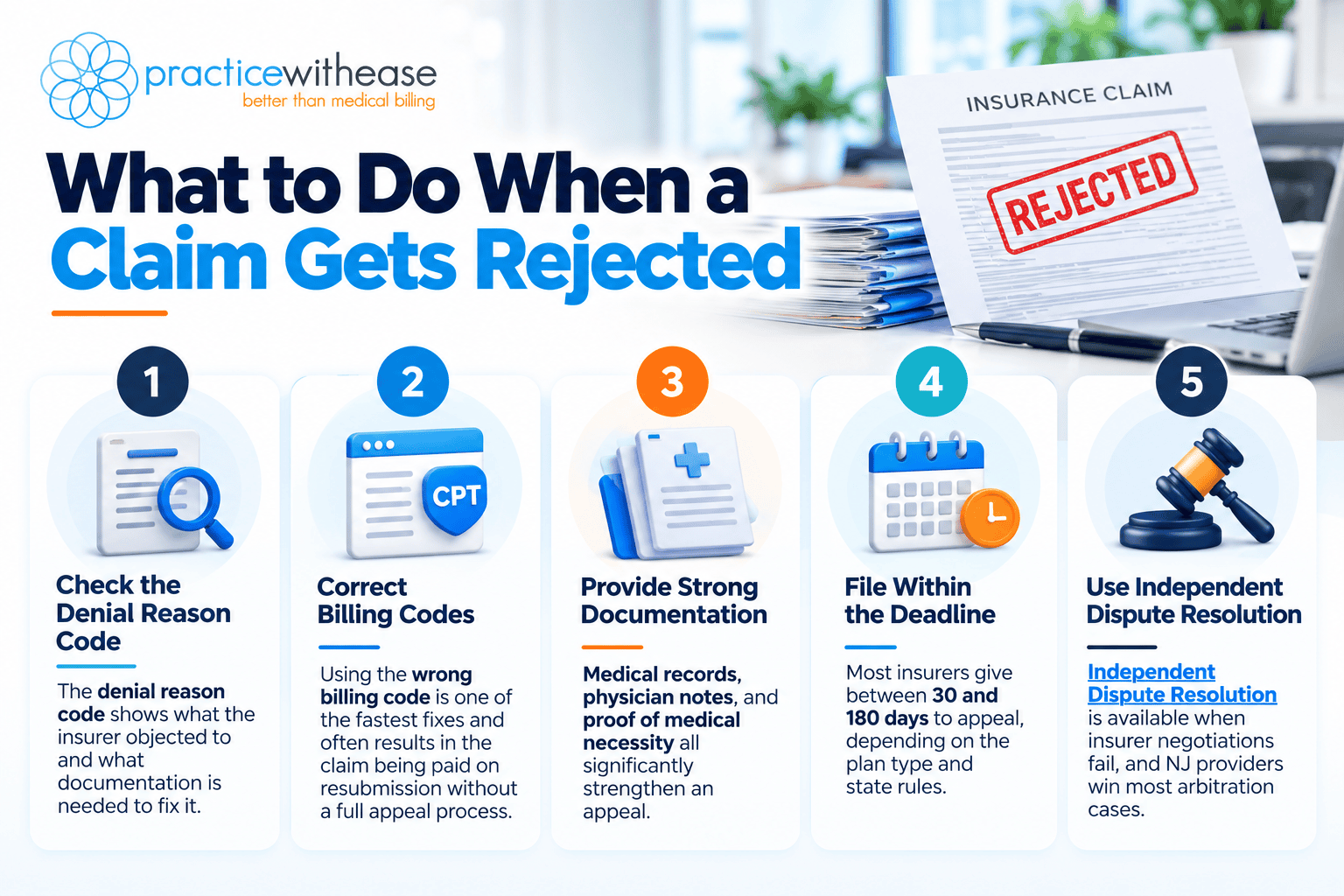
Here is what to do immediately after receiving a denial for an OON claim:
- The denial reason code shows what the insurer objected to and what documentation is needed to fix it.
- Using the wrong billing code is one of the fastest fixes and often results in the claim being paid on resubmission without a full appeal process.
- Medical records, physician notes, and proof of medical necessity all significantly strengthen an appeal.
- Most insurers give between 30 and 180 days to appeal, depending on the plan type and state rules.
- Independent Dispute Resolution is available when insurer negotiations fail, and NJ providers win most arbitration cases.
How Professional OON Billing Changes the Results
Internal billing teams are busy. Non-contracted claim appeals need specific knowledge of insurer processes and dispute-filing procedures. Most general billing staff do not have time to develop that knowledge while managing everything else.
Using a GAP Exception to Recover Payments
A GAP exception is a formal request for an insurer to treat a non-participating provider as in-network for a specific patient or care episode. This applies when a patient cannot find a qualified in-network provider nearby. Approved GAP exceptions have allowed providers to be paid at in-network rates for services that would otherwise be denied.
IDR Process: The Next Step After a Denial
The Independent Dispute Resolution process is a federal option available when a provider and insurer cannot agree on payment after the 30-day negotiation period ends. An independent third party reviews the claim and makes a binding payment decision. Most practices never start the IDR process because it feels complicated. Working with a billing specialist who handles IDR filings removes barriers and recovers claims that might otherwise go unpaid.
Frequently Asked Questions (FAQs)
Why do out-of-network claims get denied by commercial health plans more frequently than in-network claims?
Out-of-network claims experience higher denial rates because non-contracted insurers operate without pre-negotiated fee schedules, prompting rigorous scrutiny of billing details to limit reimbursement. Insurance payers frequently reject out-of-network claims for missing prior authorizations, improper CPT modifier usage, lack of detailed medical necessity documentation, or failure to meet strict timely filing windows. Ensuring complete clinical notes, verified patient eligibility, and precise coding before submission drastically reduces initial rejections.
How long does a medical practice have to appeal a denied out-of-network insurance claim?
Most commercial insurance payers allow practices between 30 and 180 days from the date on the Explanation of Benefits to file a formal appeal. Deadlines vary depending on whether the policy is governed by state insurance regulations or federal ERISA guidelines. Filing appeals immediately upon receiving a denial prevents claims from being permanently time-barred and preserves the practice’s right to pursue full reimbursement.
Can a practice dispute an insurer’s initial payment offer for a non-contracted claim?
Yes, healthcare practices can formally dispute initial insurance payments, as commercial payers routinely issue low initial reimbursements based on internal allowed amounts rather than fair market value. Providers can submit secondary appeals backed by local usual, customary, and reasonable rate benchmarks, geographic cost data, and clinical records demonstrating patient acuity to justify higher reimbursement rates.
How does Practice With Ease help medical practices recover revenue from denied out-of-network claims?
Practice With Ease provides comprehensive revenue cycle management by auditing denied claims, correcting CPT and ICD-10 coding errors, managing formal appeal submissions, requesting GAP exceptions, and initiating federal or state Independent Dispute Resolution processes. Dedicated out-of-network billing specialists identify payer denial trends and enforce timely appeals to maximize reimbursement for non-contracted services.
What is the Independent Dispute Resolution process for out-of-network claims under the No Surprises Act?
The Independent Dispute Resolution process is a federal arbitration mechanism established under the No Surprises Act to settle payment disputes between non-contracted providers and commercial health plans. After a mandatory 30-day open negotiation period fails to yield an agreed payment, an accredited certified entity evaluates final offers from both parties and selects one based on qualifying payment amounts, provider expertise, and case complexity.
What is an out-of-network GAP exception request and when should a practice submit it?
A GAP exception, or network adequacy exception, is a prior authorization request asking an insurer to cover out-of-network care at in-network benefit levels because no qualified in-network provider is available within a reasonable geographic distance. Practices should submit GAP exception requests prior to rendering non-emergent care, demonstrating that the patient requires specialized expertise or equipment not offered by contracted local providers.
What specific medical necessity documentation is required to support an out-of-network claim appeal?
A successful out-of-network claim appeal requires complete clinical notes, diagnostic testing results, conservative treatment history, clear physician progress notes, and a signed letter of medical necessity explaining why the specific intervention was required. Clear documentation must directly link the assigned ICD-10 diagnosis codes to the billed CPT procedure codes to prove the care was medically appropriate.
What are the most common coding and billing errors that lead to out-of-network claim rejections?
Out-of-network claims are most commonly rejected due to unbundling of procedure codes, missing or incorrect CPT modifiers, mismatched diagnosis codes, incorrect rendering provider NPI numbers, and failure to attach required operative reports. Using specialized out-of-network billing workflows ensures all claims are scrubbed for coding accuracy and modifier compliance prior to submission.
Are prior authorizations required for non-contracted or out-of-network medical procedures?
Yes, most commercial health plans enforce strict prior authorization requirements for non-contracted providers, particularly for elective surgeries, advanced imaging, and specialized outpatient procedures. Rendering services without securing prior authorization often results in immediate administrative claim denials that cannot be overturned through standard clinical appeals.
How should a practice handle patient financial responsibility and balance billing for out-of-network services?
Practices offering out-of-network services must establish transparent financial agreements, providing patients with Good Faith Estimates prior to treatment as required by federal regulations. While the No Surprises Act limits balance billing for emergency care and certain unscheduled out-of-network services at in-network facilities, practices offering elective non-emergent care can bill patients for remaining balances after insurance payments, provided proper written consent and fee disclosures were executed before treatment.
What is ERISA and how does it protect a practice’s right to appeal out-of-network claim denials?
ERISA, the Employee Retirement Income Security Act, governs self-insured employer health plans and sets strict federal rules for claim processing and appeals. Under ERISA, plans must provide full and fair reviews of denied claims, state the specific reason for denial, and adhere to strict response timelines. Leveraging ERISA regulations allows practices to hold commercial self-insured plans accountable during out-of-network appeal proceedings.
What is an Assignment of Benefits and why is it crucial for out-of-network insurance billing?
An Assignment of Benefits is a legal agreement signed by the patient that transfers their rights to insurance reimbursements and claim appeals directly to the healthcare provider. Having a valid, signed AOB on file gives out-of-network practices the legal standing necessary to submit claims, request reconsideration, and file formal appeals or legal action directly against insurance payers on behalf of the patient.
How do commercial insurance payers calculate the qualifying payment amount for out-of-network claims?
Commercial health plans calculate the Qualifying Payment Amount using the median contracted rate for the same or similar service in the same geographic region as of 2019, adjusted annually for inflation using the Consumer Price Index. Because the QPA is calculated internally by the payer, out-of-network providers frequently challenge low QPA determinations during Independent Dispute Resolution to demand fair market compensation.
How does Practice With Ease prevent out-of-network claims from exceeding timely filing deadlines?
Practice With Ease tracks timely filing limits across all commercial payers, which typically range from 90 to 365 days from the date of service for initial submissions and 30 to 180 days for appeals. Automated claim scrubbing, electronic submission tracking, and immediate denial routing ensure that initial claims and appeal documentation are submitted well within payer deadlines to prevent irreversible administrative rejections.
What is a Single Case Agreement and when should an out-of-network practice negotiate one?
A Single Case Agreement is a contract negotiated between a non-participating provider and an insurer for a specific patient’s treatment plan, guaranteeing pre-agreed reimbursement rates. Practices should negotiate a Single Case Agreement when a patient requires specialized, continuous care or complex surgical interventions that cannot be adequately delivered by local in-network facilities, securing payment before care is delivered.
Why do commercial insurers downcode CPT procedure codes on out-of-network claim submissions?
Commercial insurers downcode higher-complexity CPT codes to lower-reimbursement codes to reduce claim payouts under the guise of medical necessity enforcement. Downcoding commonly affects complex evaluation and management services and multi-stage surgical procedures. Reversing downcoded claims requires a formal coding appeal backed by detailed operative reports and clinical time logs demonstrating full service complexity.
How do out-of-network practices verify patient eligibility and benefits before rendering care?
Verifying out-of-network benefits involves checking the patient’s deductible, out-of-pocket maximums, co-insurance percentages, maximum allowable amounts, prior authorization requirements, and policy exclusions before treatment. Practice With Ease conducts pre-service benefit verifications to determine true insurance coverage and estimate exact patient liability before care is rendered.
What is the difference between a clinical denial and an administrative denial for an out-of-network claim?
A clinical denial occurs when the insurer asserts that the service rendered was not medically necessary, experimental, or inappropriate for the patient’s condition, requiring physician peer-to-peer reviews or clinical notes to overturn. An administrative denial results from operational or coding errors, such as missing prior authorization, incorrect patient demographics, or late filing, which are resolved through administrative re-submissions or technical appeals.
How does Practice With Ease manage the open negotiation period prior to federal IDR arbitration?
During the mandatory 30-days open negotiation period under the No Surprises Act, Practice With Ease submits formal open negotiation notices accompanied by detailed local rate benchmarks, provider qualifications, and historical reimbursement data. Dedicated negotiators engage directly with health plan representatives to settle payment disputes for fair market value before incurring formal IDR arbitration filing fees.
What role do modifier codes play in preventing out-of-network surgical and procedural claim denials?
CPT modifiers communicate crucial procedural circumstances to payers, such as distinct procedural services, multiple surgeons, or bilateral interventions. Omitting or misapplying modifiers like -25, -59, or -22 triggers automated claim edits that result in immediate unbundling denials or severe reimbursement reductions. Precise modifier usage ensures out-of-network claims reflect the exact scope of surgical care provided.
Contact Practice With Ease for Billing Help Today!
Denied claims don’t have to remain unresolved. We help medical practices recover reimbursement for claims insurers refused to pay. Schedule a free accounts receivable review to find out how much your practice is leaving on the table!